Table Of Content

As of November 2021, there were 29,648 job postings in the United States advertising design thinking as a necessary skill—a 153 percent increase from November 2020, and a 637 percent increase from November 2017. There are many models of design thinking that range from three to seven steps. During the prototype phase, you and your team design a few different variations of inexpensive or scaled down versions of the potential solution to the problem. Having different versions of the prototype gives your team opportunities to test out the solution and make any refinements. Facilitating ideation in a workshop can be both exciting and challenging.
Photo and Video User-based Studies
Design thinking is a mindset and approach to problem-solving and innovation anchored around human-centered design. These five phases are not always sequential, in that they do not necessarily need to follow any specific order and can repeat iteratively to hone and refine our solutions through the process. Avoid the perception that phases are innately hierarchical or linear; rather, they are a journey, sometimes with side stops or shortcuts, but with direction and a destination in mind. If you want your team to start using the design thinking process, but you’re unsure of how to start, here are a few tips to help you out.
User Experience: The Beginner’s Guide
Five Phases For Effective Brand Design - Forbes
Five Phases For Effective Brand Design.
Posted: Mon, 30 Mar 2020 07:00:00 GMT [source]
You’ll then get to experience the different specializations; if you come to like one of them especially, you can then dive into that one. If you cannot decide whether to be a generalist UX designer or to specialize, Stephen Gay’s advice might help you. Stephen Gay is the UX Lead of Google AdWords, and he recommends that you choose your design role based on your passion and skills. In large companies, a UX designer typically works with other designers such as UX researchers and visual designers.
Ways to Make Authentication Systems More User-friendly
Revealing this information through user interviews and other research helps prevent designers from repeating the same unsuitable solution. Designs focused on empathy for the user and centered around their wants and needs will always be superior to designs that only focus on solving the problem in the most efficient or creative way. After all, what the designer views as efficient and creative won’t always meet user needs in the best possible way.
It’s often difficult for us humans to challenge our assumptions and everyday knowledge because we rely on building patterns of thinking in order to not have to learn everything from scratch every time. We rely on doing everyday processes more or less unconsciously—for example, when we get up in the morning, eat, walk, and read—but also when we assess challenges at work and in our private lives. In particular, experts and specialists rely on their solid thought patterns, and it can be very challenging and difficult for experts to start questioning their knowledge. The core purpose of the process is to allow you to work in a dynamic way to develop and launch innovative ideas.
Browse UX / UI Design Topics

Instead, you need a blueprint for implementing the design thinking process to be able to apply the design thinking framework to your product development process. Your wireframes may also spark further ideas from the team, which is why it’s essential to treat the design thinking process as non-linear. For example, it’s fine to go back to Step 3 to iterate your prototype before moving on to the testing stage. Divergence and convergence is a human-centered design approach to problem-solving.
This feedback is then used to refine the solution and may even unearth insights that lead you back to previous steps. Design thinking is basically a problem-solving model that uses a defined five-step process to enable the effective development of new products or services. But, when you look to define a term that encapsulates a modality of thinking, you can often get stuck in quicksand, struggling to grasp exactly what it means in concrete terms. Tools like UserTesting allow you to test anything from static images to high-fidelity prototypes and collect qualitative feedback from real users or a matched audience. The benefit of this type of testing is that it requires little time to set up and doesn’t have any impact on the live product. Within the design thinking process, you might find that the hypothesis you thought was true is not what your users are looking for.
Design thinking is a broader framework that borrows methods from human-centered design to approach problems beyond the design discipline. It encourages people with different backgrounds and expertise to work together and apply the designer’s way of thinking to generate innovative solutions to problems. Prototypes can allow designers to create innovative solutions that haven’t been thought of yet. When a design team isn’t restricted by current modalities, or current technologies, they can create prototypes that break away from those conventions. It’s why so many designers still prefer to create initial wireframes and prototypes with pen and paper rather than software—it allows them to create whatever they can imagine without restraint. We designers seem to be inventing new job titles each year to describe vaguely overlapping roles, so it’s not a surprise if you’re feeling lost!
This influential book explores how design shapes our interactions with the world around us, providing insights that are applicable to digital product design as well. It examines the psychology of everyday objects and experiences, and highlights the importance of user-centered design. When UX professionals understand how people perceive and engage with the designed world, they can create more intuitive, meaningful, and satisfying digital experiences. Still, to select the most suitable UX design process for a project depends heavily on how well designers or design teams understand the project's unique context, goals, user needs and constraints.
Here, we’ll analyze six common UX roles through how they contribute to the design process and shine a light through the fog of UX roles. Soon, you’ll clearly understand which job role is best for you to aim for. Through these collaborative efforts, UX designers, developers, and product managers strive to create products that are not only functional but also provide a delightful user experience. The key is to remain focused on the user's needs while balancing technical constraints and business goals. This holistic approach not only enhances the user experience but also contributes to the overall success of the product in the market.
DV leans heavily on customer research as a tool for identifying exciting market opportunities, and this is underpinned by the design thinking process, which places the customer’s needs first. The fourth stage of the process is where you’ll draw up a prototype — an inexpensive version of the final product. With the prototype, you can invite criticism and troubleshoot any issues you encounter. We learn by seeing things done through our own eyes, not just by reading about them.
In practice, the best prototypes provide just enough context to keep users focused on the aspects you want to learn about. Sharing inspiring or innovative solutions among the team helps spark new ideas and creates a frame of reference for members with widely different professional disciplines or experiences. When planning a Design Thinking workshop, save time to have participants discuss a design or service that has personally surprised or delighted them. And be sure to look for inspiration outside your sector — hospitals can learn a lot from hospitality and vice versa. The most successful design thinking projects begin with a shared understanding of what success looks like. Discussing the quantitative and qualitative KPIs early in the process helps teams have better conversations about the feasibility and viability of their ideas.
If teams begin with technical constraints, they might restrict innovation. The first step in design thinking is to understand the problem you are trying to solve before searching for solutions. Sometimes, the problem you need to address is not the one you originally set out to tackle.
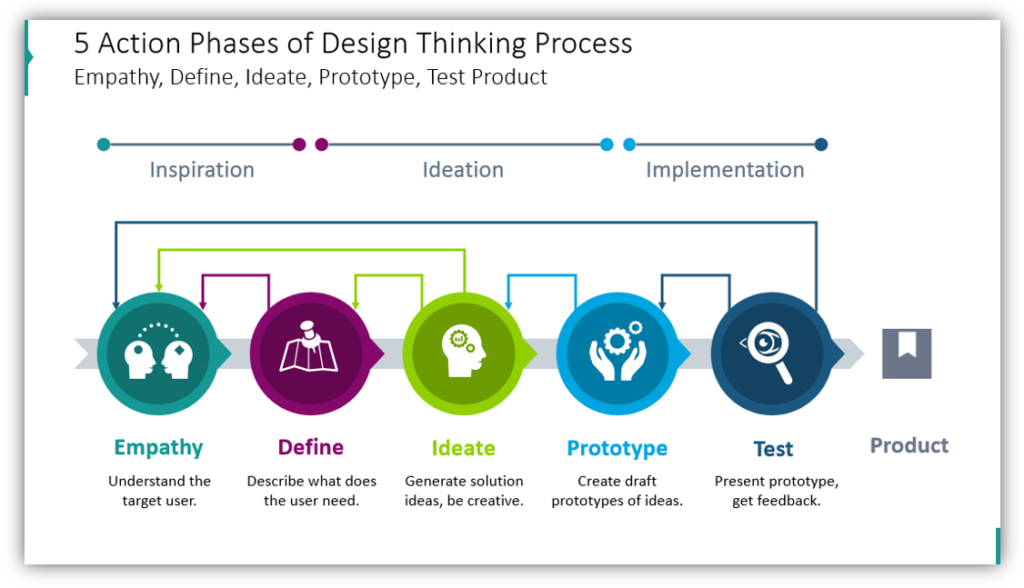
The first stage of the design thinking process focuses on user-centric research. You want to gain an empathic understanding of the problem you are trying to solve. Consult experts to find out more about the area of concern and conduct observations to engage and empathize with your users.
This book introduces a Lean UX framework that encourages a more iterative, outcomes-focused approach to UX design. It explains how to apply Lean principles, such as removing waste, improving team efficiency, and shifting away from relying on a single expert. The book equips designers with the tools and strategies to create effective user experiences while optimizing their design process for speed and flexibility. Simply put, the Design Thinking process is a playbook that helps teams shape a field of opportunities into specific innovations. It breaks down the human-centered design process into a series of stages and steps, and guides complex collaborations with tools and activities. The first stage of design thinking lays the foundation for the rest of the process because it focuses on the needs of the real people using your product.
In addition to finding out what ideas they’ve already tried, including them in brainstorming sessions encourages them to buy into the design process. Hearing the reasoning behind why certain options are disqualified from the start—or considered to be worth a try, can reduce resistance later in the process. Design thinking goes beyond the usual problem-solving focus of most UI and UX designers and adds the aspect of deep empathy for the user to the entire product design lifecycle, increasing the prospect of success.


No comments:
Post a Comment